4 Stroke Engine: How It Works, with Diagram
A 4 stroke engine completes one power cycle in four piston strokes: intake, compression, power and exhaust. See the labelled diagram, the main parts and how lubrication works.


A 4 stroke engine is an internal combustion engine that completes one power cycle in four piston strokes: intake, compression, power and exhaust. The crankshaft turns twice for every cycle, and only one of the four strokes produces power. Almost every car, motorcycle and scooter sold in India today runs on this cycle.
4 stroke engine diagram
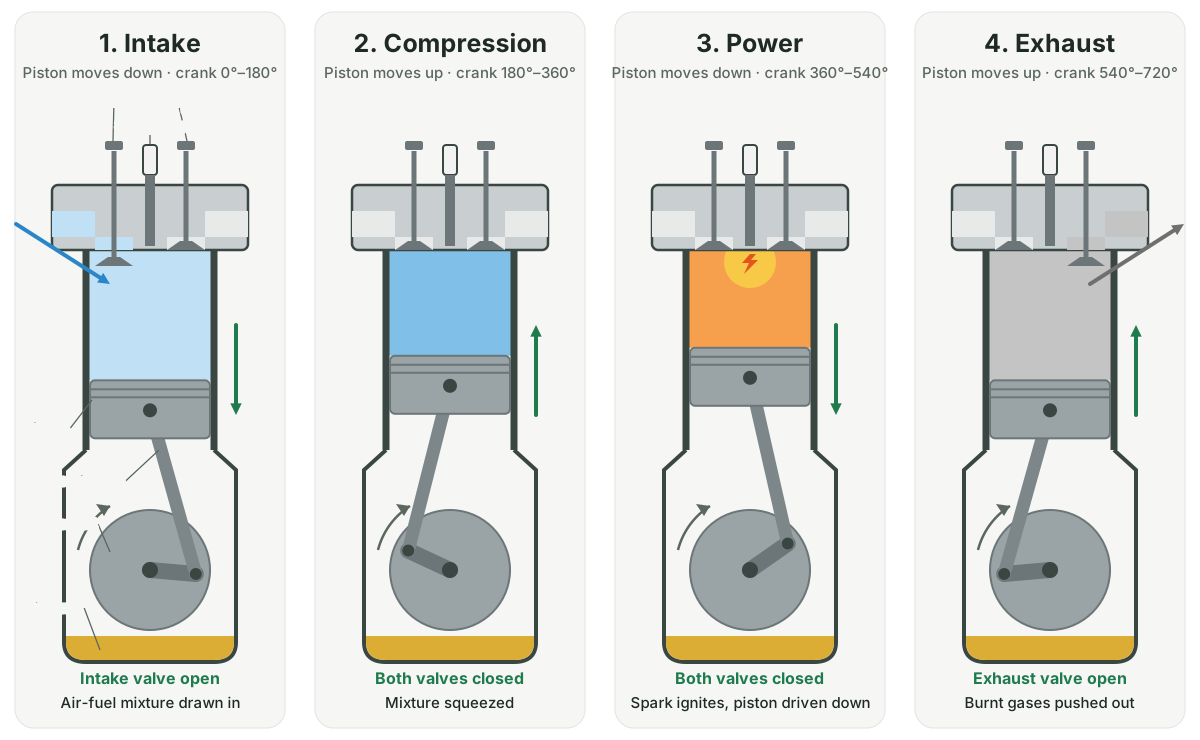
The four strokes of a petrol engine. The piston moves down, up, down, up while the crankshaft completes two full turns.
The four strokes, step by step
1. Intake stroke
The intake valve opens and the piston moves down. The falling piston draws a mixture of air and petrol into the cylinder. The exhaust valve stays shut.
2. Compression stroke
Both valves close. The piston moves up and squeezes the mixture into a small space at the top of the cylinder. Squeezing raises its pressure and temperature, which makes the burn stronger.
3. Power stroke
Just before the piston reaches the top, the spark plug fires. The mixture burns and expands, forcing the piston down. This is the only stroke that does useful work. The connecting rod passes this push to the crankshaft.
4. Exhaust stroke
The exhaust valve opens. The piston moves up again and pushes the burnt gases out through the exhaust port. The cycle then starts over.
| Stroke | Piston movement | Intake valve | Exhaust valve | What happens |
|---|---|---|---|---|
| Intake | Down | Open | Closed | Air-fuel mixture enters |
| Compression | Up | Closed | Closed | Mixture is compressed |
| Power | Down | Closed | Closed | Spark ignites mixture, piston is driven down |
| Exhaust | Up | Closed | Open | Burnt gases leave |
Four strokes equal two crankshaft revolutions, or 720 degrees of rotation. The camshaft, which opens the valves, turns at half the crankshaft speed so each valve opens once per cycle.
Main parts of a 4 stroke engine
| Part | Job |
|---|---|
| Cylinder | The chamber in which the piston moves |
| Piston | Moves up and down, transfers combustion force |
| Piston rings | Seal the gap between piston and cylinder, control oil |
| Connecting rod | Links the piston to the crankshaft |
| Crankshaft | Converts up-and-down motion into rotation |
| Camshaft | Opens the valves at the right time |
| Intake and exhaust valves | Let mixture in and burnt gas out |
| Spark plug | Ignites the mixture in a petrol engine |
| Oil sump and oil pump | Store engine oil and circulate it |
Four stroke petrol engine and diesel engine: the difference
Both follow the same four strokes. They differ in how the fuel ignites.
| Point | Petrol engine | Diesel engine |
|---|---|---|
| What enters on intake | Air and petrol mixture | Air only |
| Ignition | Spark plug | Heat of compression |
| Typical compression ratio | About 8:1 to 12:1 | About 14:1 to 22:1 |
| Fuel delivery | Carburettor or fuel injection | Injected at the end of compression |
A diesel engine has no spark plug. It compresses air until it is hot enough to ignite the diesel sprayed into it.
4 stroke and 2 stroke engines compared
| Point | 4 stroke | 2 stroke |
|---|---|---|
| Power strokes | One every two crankshaft revolutions | One every revolution |
| Valves | Intake and exhaust valves | Ports in the cylinder wall |
| Lubrication | Separate oil in the sump | Oil mixed with or injected into fuel |
| Fuel economy | Better | Lower |
| Emissions | Lower | Higher |
| Oil used | 4T engine oil | 2T oil |
This is why 4T oil and 2T oil are not interchangeable. A 2T oil is designed to burn with the fuel. A 4T oil is designed to stay in the engine and circulate.
How lubrication works in a 4 stroke engine
A 4 stroke engine keeps its oil in a sump at the bottom of the crankcase. An oil pump draws oil from the sump and sends it under pressure to the crankshaft bearings, the camshaft and the valve gear. Oil thrown off the spinning crankshaft splashes onto the cylinder walls and the underside of the piston. It then drains back to the sump and goes round again.
In that loop the oil does five jobs:
- Reduces friction by keeping a film between metal surfaces
- Carries heat away from the piston and bearings
- Cleans by holding soot and deposits in suspension until the next oil change
- Seals the gap between piston rings and cylinder wall
- Protects against rust and acid corrosion
Oil wears out doing this work. Heat thins it, and combustion by-products contaminate it. That is why every manufacturer sets an oil change interval.
What exhaust smoke tells you about a 4 stroke engine
Once you know the four strokes, exhaust smoke becomes easy to read.
| Smoke | Likely cause | Where it goes wrong |
|---|---|---|
| Blue or grey | Engine oil is burning | Worn piston rings or valve stem seals let oil into the cylinder |
| Black | Too much fuel, too little air | Clogged air filter or a rich fuel mixture on the intake stroke |
| Thick white, sweet smell | Coolant is burning (liquid-cooled engines) | Leaking head gasket lets coolant into the cylinder |
| Thin white on a cold morning | Normal condensation | Clears within a minute or two |
Blue smoke along with a falling oil level means the engine is consuming oil. Check the level weekly and have the engine inspected.
Choosing oil for a 4 stroke engine
Three markings on the pack tell you whether an oil suits your engine.
- SAE viscosity grade, such as 10W-30 or 20W-40. Use the grade in your owner's manual.
- API service level, such as SL or SN for petrol engines and CI-4 or CK-4 for diesel engines. A later letter generally means a newer standard.
- JASO class for two-wheelers. MA or MA2 for motorcycles with a wet clutch, MB for scooters.
For scooters specifically, see our guides to engine oil for the Honda Activa and the best engine oil for scooty and scooter.
RBM Oil Corporation makes 4 stroke engine oils for scooters, motorcycles, cars and diesel engines. See the automotive range or contact us for help with a grade.
Frequently asked questions
Why is it called a 4 stroke engine?
Because the piston makes four strokes, two down and two up, to complete one power cycle.
How many crankshaft revolutions does one cycle take?
Two revolutions, which is 720 degrees.
Which stroke produces power?
Only the third, the power stroke. The flywheel's momentum carries the engine through the other three.
Can I use 2T oil in a 4 stroke engine?
No. 2T oil is made to burn with fuel and does not protect a 4 stroke engine's bearings and valve gear.
Is a scooter engine a 4 stroke engine?
Yes. Current petrol scooters and motorcycles in India use 4 stroke engines.
Related guides
Have specific lubrication questions?
Connect directly with our Pune technical lab team to match viscosity grades and obtain certified Technical Data Sheets (TDS).
Related Engineering Insights
 Automotive
Best Engine Oil for Scooty and Scooter: How to Choose
The best engine oil for a scooty matches three markings in your owner's manual: SAE 10W-30, JASO MB and API SL or higher. Here is how to choose, how much it takes and what to avoid.
AutomotiveEngine Oil for Activa: Right Grade, Capacity and Change Interval
The right engine oil for a Honda Activa is SAE 10W-30 with a JASO MB rating and API SJ or higher. See how much oil each Activa model holds, and how to check and change it.
 Market Insights
ENEOS 2028 Strategic Shift: Closing Yokohama Lubricant Production to Drive Innovation
Japan’s largest oil refiner, ENEOS Corporation, has announced a big change in its operations, closing Yokohama lubricant production to drive innovation — the company will stop producing lubr...